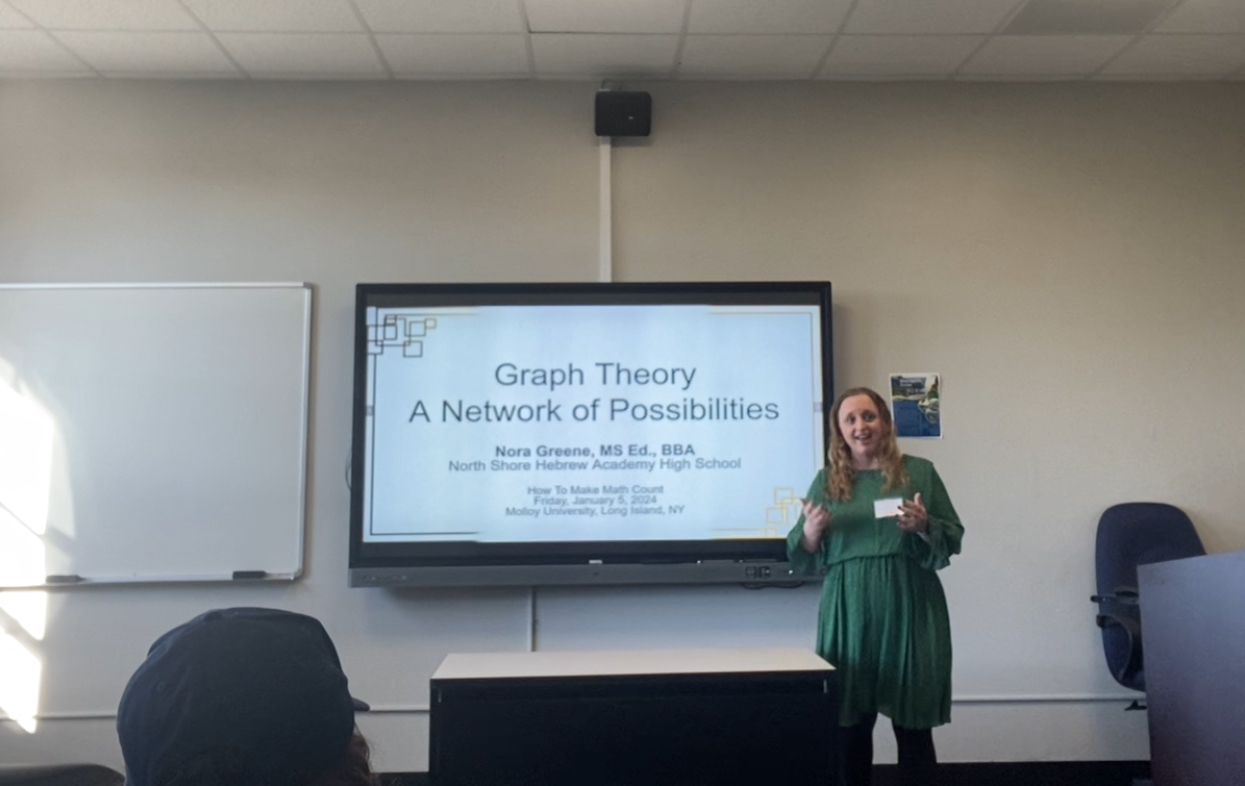
On Friday, 1/5/24, I presented for the first time at the conference: “How To Make Math Count.” This conference is geared toward K-8 educators, and is hosted by Nassau County Mathematics Teachers Association and Nassau County Association of Math Supervisors. The conference is held annually at Molloy University.
The title of my presentation is: “Graph Theory: A Network of Possibilities.” The inspiration for this presentation is derived from two experiences: teaching my senior Finite Math class, and interacting with my seven year old son, who is in second grade.
Trying something new for the first time is more exhilarating than scary, in my opinion. I’m good at public speaking, both in the classroom and in front of larger groups of varying ages, so speaking about this topic for 50 minutes was not a daunting task. Rather, it was a welcome experience that I used as an opportunity to practice these skills. Each session only had about 10-15 participants, which is smaller than most of my classes!
I first started exploring this topic while at a restaurant with my family. My son was anxiously awaiting the food to arrive, when I challenged him to a map coloring exercise. I drew a picture on a piece of paper, and challenged him to color in the shapes of the picture using four different colored crayons, where no two colored shapes can share a border. He completed the task and enjoyed it! So, I knew I had to teach Graph Theory to my Seniors. When teaching Graph Theory to my Finite Math class, I realized that these students had previously been exposed to Graph Theory in their formative school years. Family Trees, Life Cycles, Social Networks – are all amazing examples of Graph Theory put to practical use! Graph Theory is the study of connections, rather than the study of quantitative data, alone. After seeing my students completely engaged in a Geogebra Map Coloring exercise, I knew I had to keep the momentum going during my conference presentation.
At the conference, I walked my participants through the history of Graph Theory, some examples often used in classrooms and in daily life, and then finally culminated in two of the most famous examples: Bridges of Konigsberg problem, which put Graph Theory “on the map” (pun intended), and Map Coloring. After about 40 minutes of discussion and exploration, participants used a QR code to navigate to a Geogebra Map Coloring exercise, and also used crayons to complete differentiated map coloring worksheets (simple to complex).
Feedback was mostly positive, with some constructive criticism, of course. The positive feedback included that I was animated, passionate, knowledgable, and insightful. Participants appreciated that I exposed them to an area of math that they otherwise would not learn. The constructive criticism I received was that the topic was not exactly aligned with these teachers’ curriculum – that they didn’t feel they walked away with specific tools they could use for specific lessons.
However, that wasn’t the primary goal of the presentation. The primary goal was to help educators think outside the box. I wanted to showcase an area of mathematics often reserved for advanced or older students, and how that could apply to younger students’ learning. In the end, participants walked away knowing a little bit more about Graph Theory than when they started, and were excited to know that it is possible to differentiate all types of mathematics, including mathematics that isn’t exactly listed on a curriculum map.
Sometimes learning for the sake of learning is the most fun and interesting – which is exactly what we were all doing together as peers at the How To Make Math Count conference.
I was asked to speak again next year – time to start brainstorming my next topic!

From my school’s parent newsletter: “Math Faculty Member Nora Greene Makes Advanced Math A Breeze at Annual Conference” – “How early can students grasp Graph Theory? According to math teacher Ms. Nora Greene, even our youngest learners can understand its complexities. Ms. Greene was recently chosen to present at the annual How to Make Math Count Conference. The event, which is organized by the Nassau County Math Teachers Association and Nassau County Association of Math Supervisors, brought together hundreds of mathematics educators at Molloy University for a day of learning, activities, and conversation. Ms. Greene, who has been teaching high school math for 13 years, took the stage to demonstrate how Graph Theory – a topic usually reserved for advanced high school and college math classes – can be made engaging and exciting at lower grade levels. With age-appropriate tools and techniques, Ms. Greene shared, younger students can intuitively grasp this complex, fascinating area of math and prepare for higher-level learning. Congratulations to Ms. Greene on this accomplishment! We can’t wait to hear how her innovative ideas change the Graph Theory game for teachers across Long Island.”

 Nora A. Greene, MS. Ed, BBA